

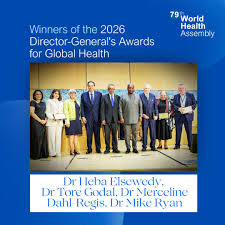
The World Health Organization (WHO) Director-General, Dr Tedros Adhanom Ghebreyesus, has presented the prestigious Director-General’s Award for Global Health to four distinguished leaders in recognition of their lifelong contributions to improving health outcomes worldwide.
The awards were presented during the high-level welcome session of the 79th World Health Assembly in Geneva, under the theme “Reshaping global health: a shared responsibility.”
This year’s recipients include Dr Tore Godal (Norway), Dr Merceline Dahl-Regis (The Bahamas), Dr Mike Ryan (Ireland), and Dr Heba Elsewedy (Egypt), all recognised for exceptional leadership across immunisation, epidemic response, health systems strengthening, and humanitarian health services.
A celebration of global health leadership
Dr Tedros described the awardees as individuals whose work has delivered “outstanding lifetime contributions to global health,” highlighting their impact in advancing equitable access to healthcare, strengthening outbreak preparedness, and improving community health systems.
The Director-General’s Award for Global Health, established in 2019, recognises individuals whose leadership has produced measurable improvements in global health outcomes.
Contributions of the 2026 awardees
Dr Tore Godal was recognised for his pioneering role in advancing global immunisation systems and infectious disease control. His work contributed to major initiatives such as Gavi, the Vaccine Alliance, and global malaria and epidemic preparedness programmes.
Dr Merceline Dahl-Regis was honoured for her leadership in disease elimination efforts across the Americas, including contributions that helped make the region the first to eliminate measles and rubella.
Dr Mike Ryan received recognition for his leadership in global health emergencies, including outbreak response systems and coordination during major epidemics such as Ebola and COVID-19.
Dr Heba Elsewedy was acknowledged for her humanitarian work in burn care, trauma support, and rehabilitation services, focusing on restoring dignity and care for vulnerable populations.
According to WHO, the achievements of the 2026 laureates reflect the diverse approaches needed to achieve universal health coverage and stronger global health security. Their work spans scientific innovation, emergency response, immunisation, and community-based care models.
The ceremony formed part of broader discussions at the World Health Assembly, where member states are addressing global health financing, epidemic preparedness, and equitable access to essential health services.
 English