

By Steven O. Mukoro
A hidden virus lurking inside gut bacteria may be the missing link behind colorectal cancer risk.
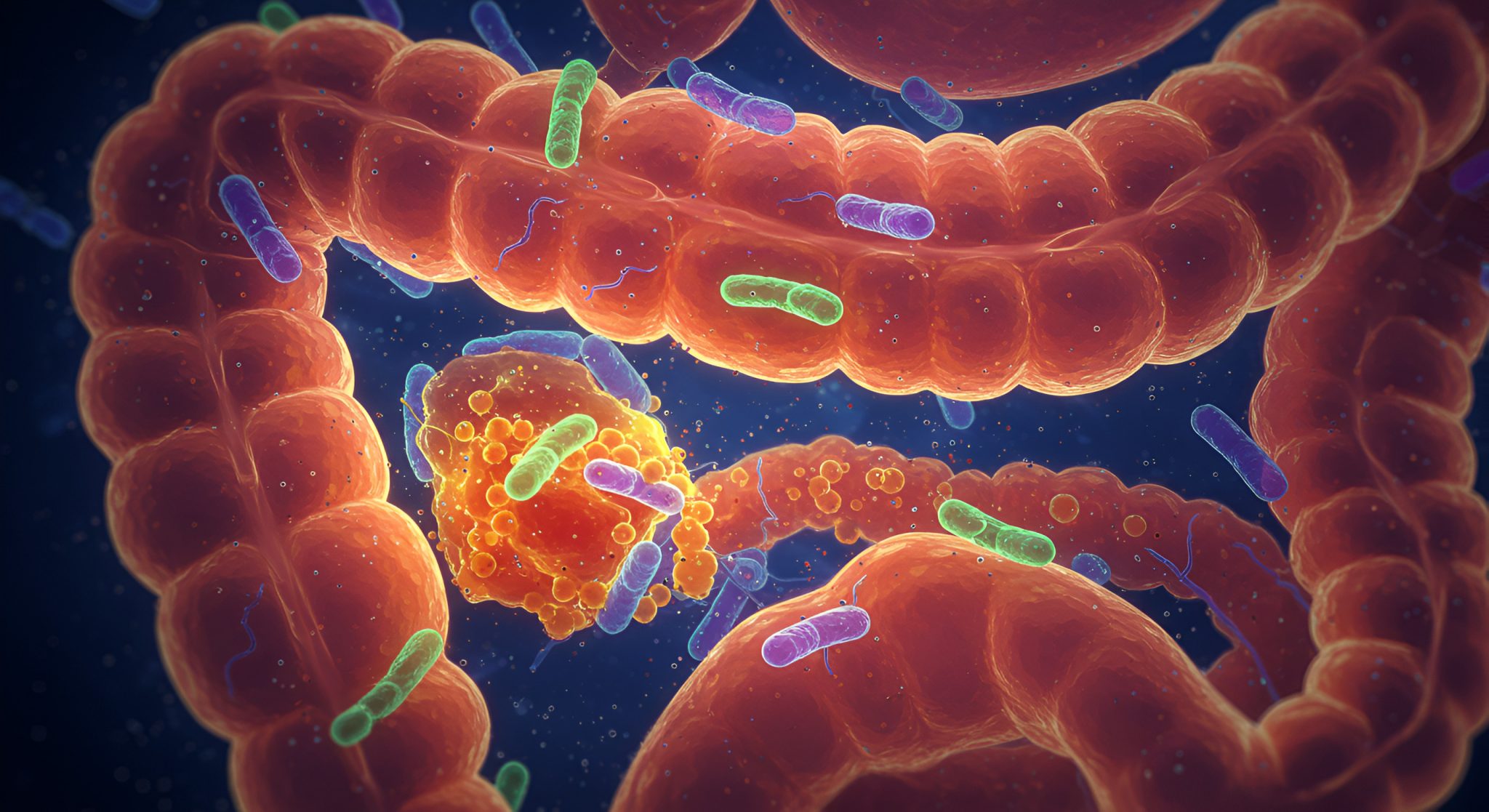
Researchers have identified a previously unknown virus concealed within a common gut bacterium, a discovery that could help solve a long-standing medical mystery: why a microbe found in both healthy individuals and cancer patients has been repeatedly linked to colorectal cancer. The findings suggest that the relationship between bacteria and the viruses they carry may play a crucial role in determining disease risk and could eventually lead to new screening methods capable of detecting cancer risk earlier.
Colorectal cancer is one of the most common cancers in Western countries and remains a leading cause of cancer-related deaths. Although factors such as age, diet, and lifestyle are known to influence risk, the precise triggers behind the disease are still not fully understood.
In recent years, scientists have turned increasing attention to the gut microbiome — the vast community of bacteria, viruses, and other microorganisms living in the digestive tract.
Now, researchers from University of Southern Denmark and Odense University Hospital have discovered a previously unknown virus inside a common gut bacterium. The virus appears more frequently in people with colorectal cancer, offering an important new clue about how the disease may develop.
A Common Gut Bacterium With a Long-Standing Mystery
For years, scientists have linked the bacterium Bacteroides fragilis to colorectal cancer. Yet the connection has remained puzzling because the same bacterium is also commonly found in healthy people.
“It has been a paradox that we repeatedly find the same bacterium in connection with colorectal cancer, while at the same time it is a completely normal part of the gut in healthy people,” remarks Flemming Damgaard, medical doctor and PhD at the Department of Clinical Microbiology at Odense University Hospital and the University of Southern Denmark.
To explain this contradiction, the researchers examined whether important differences might exist within the bacterium itself.
What they discovered was striking.
Discovery of a Virus Inside Gut Bacteria
The crucial difference appeared to be a virus living inside the bacterium. In patients who later developed colorectal cancer, Bacteroides fragilis was far more likely to contain a specific bacteriophage — a virus that infects bacteria.
“We have discovered a virus that has not previously been described and which appears to be closely linked to the bacteria we find in patients with colorectal cancer,” says Flemming Damgaard.
The study team thinks this virus signify entirely new forms that have not previously been known.
“It is not just the bacterium itself that seems interesting. It is the bacterium in interaction with the virus it carries,” he explains.
While the research reveals a strong statistical tie between the virus and colorectal cancer, it does not confirm that the virus causes the ailment.
“We do not yet know whether the virus is a contributing cause, or whether it is simply a sign that something else in the gut has changed,” says Flemming Damgaard.

Large-Scale Data Reveals a Clear Pattern
The discovery emerged from a major Danish population study involving nearly two million people. Researchers examined patients who had suffered serious bloodstream infections caused by Bacteroides fragilis. Among them, a small number were diagnosed with colorectal cancer within a few weeks.
When the researchers compared bacterial samples from patients with cancer to those without, a distinct pattern became clear. Bacteria taken from cancer patients were far more likely to carry certain viruses.
Although the early findings were based on a relatively small group of Danish samples, they provided strong evidence and an important foundation for deeper investigation.
“It was in our Danish material that we first detected a signal. That gave us a concrete hypothesis, which we were then able to investigate in larger datasets,” says Flemming Damgaard.
Established Across Almost 900 Patients globally
To determine whether the pattern extended beyond Denmark, the researchers analyzed stool samples from 877 individuals in Europe, the United States, and Asia.
The findings remained consistent across all regions. People with colorectal cancer were roughly twice as likely to carry these viruses in their gut microbiome.
“It was important for us to examine whether the association could be reproduced in completely independent data. And it could,” says Flemming Damgaard.
Although the findings strengthen the connection, they do not prove that the virus directly causes colorectal cancer.
A New Perspective on Cancer Risk
Scientists estimate that up to 80 percent of colorectal cancer risk may be influenced by environmental factors, including the microorganisms that inhabit the gut.
The gut microbiome is extraordinarily complex, made up of thousands of bacterial species and an even greater amount of genetic diversity. This complexity has long made it challenging for researchers to identify the specific differences between healthy individuals and those who go on to develop disease.
“The number and diversity of bacteria in the gut is enormous. Previously, it has been like looking for a needle in a haystack. Instead, we have investigated whether something inside the bacteria — namely viruses — might help explain the difference,” says Flemming Damgaard.
If the virus alters the behavior of the bacterium, it could reshape the gut environment in ways that increase cancer risk. Researchers are now investigating this possibility further.
“We do not yet know why the virus is present, but we are investigating whether it contributes to the development of colorectal cancer,” he says.
Could This result in New Screening analyses?
At present, colorectal cancer screening commonly relies on stool tests designed to detect hidden traces of blood.
In the future, researchers believe these screening methods could also include tests for the newly identified viruses.
“In the short term, we can investigate whether the virus can be used to identify individuals at increased risk,” says Flemming Damgaard.
Early analyses suggest that certain viral markers could help identify roughly 40 percent of colorectal cancer cases, while remaining absent in most healthy individuals.
Still, the researchers caution that the findings are preliminary. More research will be required before the approach could be applied in clinical settings.

Key Terms
Bacteroides fragilis
A common gut bacterium found in many healthy people. Although it has long been associated with colorectal cancer, it is also frequently present in individuals without the disease.
Bacteriophages
Viruses that infect bacteria. These viruses can alter the characteristics and behavior of the bacteria they inhabit.
Microbiome
The vast community of microorganisms — including bacteria, viruses, and fungi — that live in and on the human body
Three Questions for Flemming Damgaard
What did you investigate?
We examined how gut bacteria may contribute to the development of colorectal cancer.
What is the study’s most important finding?
We identified a new and previously unknown virus that infects gut bacteria in patients with colorectal cancer.
How could the findings be used?
In the future, it may become possible to screen stool samples for these viruses to help assess colorectal cancer risk and potentially improve prevention and treatment strategies.
Ongoing Research Projects
Flemming Damgaard and his colleagues are continuing the research through three separate projects:
· Researchers are growing Bacteroides fragilis carrying the virus in an artificial gut model to study how the bacterium, virus, and gut tissue interact. The project is funded by the Louis Hansen Foundation.
· Scientists are preparing to examine colorectal cancer tumors directly to determine whether both the bacterium and the virus are present within tumor tissue. This work is funded by the Novo Nordisk Foundation.
· Researchers will also test whether mice genetically predisposed to cancer develop the disease faster when the virus-carrying bacterium is present in their gut. This project is supported by the Erichsen Family Memorial Foundation.
About the Study
The research began with Danish patients who had suffered serious bloodstream infections caused by Bacteroides fragilis. Scientists compared bacterial samples from patients who later developed colorectal cancer with samples from those who did not.
The findings were then further examined using stool samples from 877 people with and without colorectal cancer across several countries to determine whether the same viruses appeared more frequently in cancer patients.
The study received support from the Region of Southern Denmark, the Harboe Foundation, and the Novo Nordisk Foundation.


 English