
By Deborah Bamisaye
It’s been a five series journey and it feels good to want to wrap up after this one. I mean on the seventh one where you need to see more on today’s sub-topic: ‘A dangerous little sentence hiding in many kitchens.’
You see, it sounds harmless – almost innocent.
You hear it after dinner; you hear it after shopping.
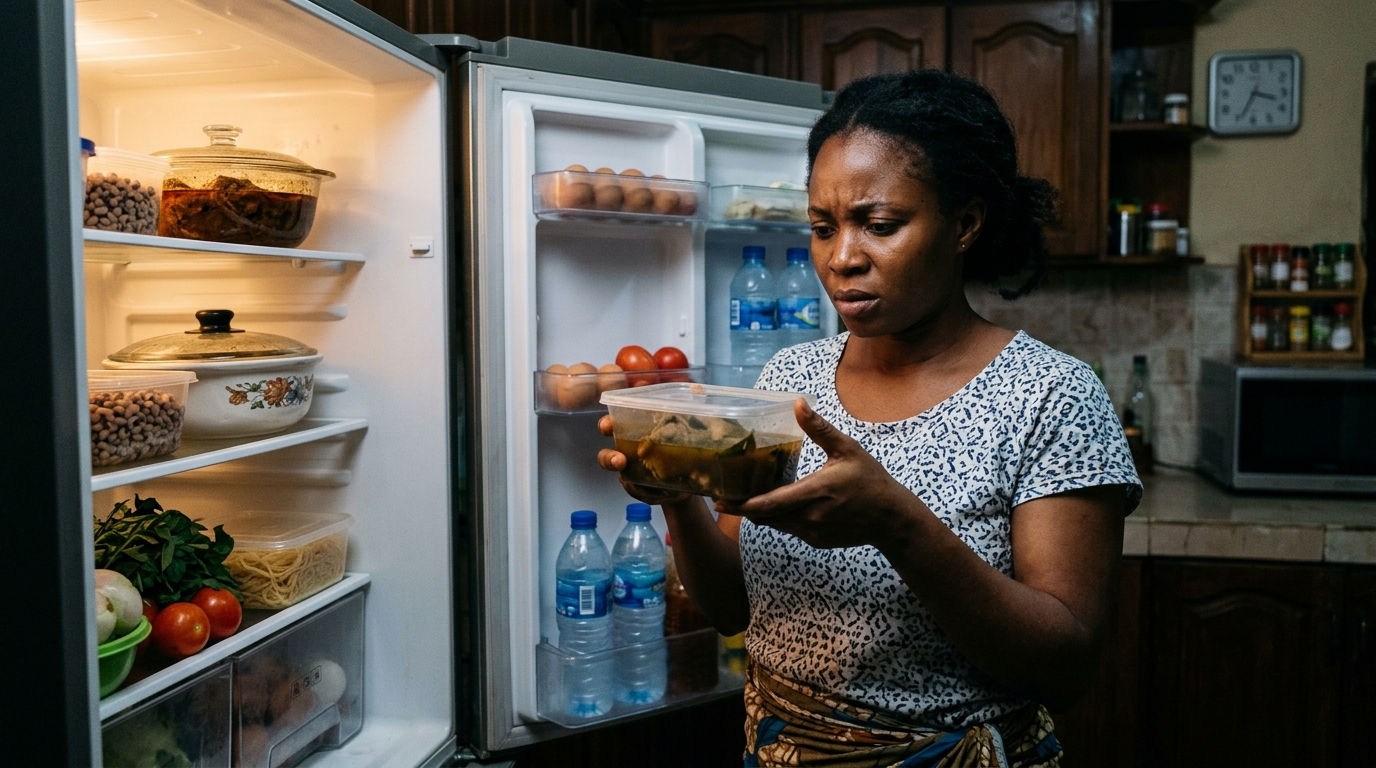
You hear it when someone opens the refrigerator and sees yesterday’s leftovers.
It usually sounds like this: “It should still be fine. Let’s take it!”
Should; Still; Fine.
Three little words… and then another three…
Let’s; Take; It.
And this has encouraged some very questionable decisions. As you well know, food doesn’t always give us a dramatic warning when something is going wrong. Sometimes, nothing happens at all.
No strange smell; No frightening colour; No mould.
No suspicious appearance – Just time passing. And that brings us to a question we haven’t really asked throughout this refrigeration journey: How long is “too long”? Not…“When does the food look bad?” Not…“When does it smell funny?” But: “How long has this food been living under these conditions?” Because sometimes, the biggest mistake in the kitchen isn’t putting the wrong food in the refrigerator, it is assuming that refrigeration gives food unlimited time. And it doesn’t.
The Refrigerator Is A Pause Button – Not A Time Machine
Think about that for a moment. When you place food in the refrigerator, you are not pressing a magical button that says: “SAFE FOREVER.” You are slowing things down. Yes! Cold temperatures slow the growth of many microorganisms but they don’t stop time. They don’t erase previous mistakes and they don’t turn food that has already been mishandled into safe food again. That means the journey matters. There are questions to answer?
- What happened before refrigeration?
- How quickly was the food chilled?
- How long was it left outside?
- How was it handled?
- And how long has it already spent inside the refrigerator?

Suddenly, that innocent question, “Is it still okay?” becomes much more complicated.
Can Leftovers Win this Argument?
Let’s say you cooked a delicious pot of stew.
Everyone ate. There is still plenty left.
You look at it, it looks perfectly normal.
“There’s no need to waste this.” Fair enough but then the evening gets busy. The food sits out.
You eventually remember it. Into the refrigerator it goes.
The next day, someone asks: “Can we eat this?” And the answer cannot simply be: “Yes. It was refrigerated.”
The better question is: “When was it refrigerated?” That one detail can completely change the story.
This is why safe food handling isn’t simply about where food is kept – It is also about when it gets there.
The Innocent Looking Food
Here’s another trap.
You open the refrigerator and find something that looks perfectly normal.
You smell it – nothing unusual.
You think: “It’s fine.”
But here’s where we need to be careful: ‘Our eyes and noses are useful. They can alert us to obvious spoilage.’
But are they laboratory equipment? Of course not! Some harmful microorganisms do not change the appearance, smell, or taste of food. So, please don’t make your tongue the food-safety inspector. “Let me taste it and see” is not a safety test. If food has been stored improperly or left out for too long, tasting a little is a gamble, and that doesn’t make the gamble safer.
The Foods That Need Your Attention
Now, let’s move away from the usual suspects of rice and a few others. Think about some foods that quietly become part of everyday life: Cooked beans, Soups and stews; cooked fish, cut fruits and vegetables, Sandwiches and other ready-to-eat foods, and cooked pasta. These foods may look completely ordinary after a few hours or even after spending some time in the refrigerator. But their safety depends on time, temperature, handling and storage conditions.
And that’s why leftovers should never become a permanent resident of your refrigerator simply because: “There is still space.” Your refrigerator is not a museum for forgotten meals, is it?

Ever heard of The “Just One More Day” Trap?
This one deserves attention:
Day one: “It’s still good.”
Day two: “It’s definitely still good.”
Day three: “Let’s just finish it.”
Day four: “Nobody has complained yet.”
And suddenly…the refrigerator has become a retirement home for leftovers. But food safety doesn’t work by majority vote. If you’re unsure how long a particular food can safely be stored, don’t guess. Check reliable food-safety guidance or the manufacturer’s storage instructions. And when food has been kept under questionable conditions? Don’t let the fear of wasting food persuade you to take an unnecessary risk – that’s very important. I also want to say that, do you think it is wise to do some labelling with paper-tape or whatever works, just to indicate the date or time a food is stored, so as to take informed-eating-decisions? You decide!
The Temperature?
Yes! The temperature. Here’s something many people overlook. ‘A refrigerator can be cold…and still not be cold enough.’ A refrigerator should generally be kept at 4°C or below for safe storage of perishable foods. And if the fridge is repeatedly opened, overloaded, poorly maintained, or struggling to cool properly, the actual temperature of the food may not be what you assume. That’s why one of the smartest little investments in a kitchen isn’t another container.
it is knowing: How cold is my refrigerator actually?
So, What Have We Really Learned?
Look at the journey we’ve taken. We started by discovering that some foods were begging: “Keep me out!” Then we discovered that some foods had enemies. We entered the refrigerator and discovered that even its shelves have a purpose. We followed food beyond storage and discovered that the cutting board can become a hidden point of contamination. And now.., we have arrived at perhaps the most important lesson of all: Safe storage is not simply about putting food somewhere cold, it is about understanding time + temperature + handling + separation.
Miss one…and the chain could be weakened.
So, where is the wisdom in all these? What are the chances that we have to keep safe? Does the World Health Organization have a take on this? Let’s find out about all these and more as we conclude with the last episode. Don’t miss it! It will be nice to see you
 English